5 min read

What is Attribute-Based Access Control (ABAC)? | MindLink

What is Attribute-Based Access Control (ABAC)? | MindLink

As organisations become increasingly connected, controlling who can access sensitive information has become one of the biggest challenges in cybersecurity. Traditional methods of granting access based on job titles or network location are no longer sufficient in environments where users work across multiple organisations, security domains and classified networks.

Attribute-Based Access Control (ABAC) provides a far more flexible and secure approach. Instead of relying solely on predefined user roles, ABAC evaluates multiple characteristics—or attributes—before granting access to data or allowing an action to take place.

The result is more precise, context-aware security that supports Zero Trust architectures, coalition operations and secure cross-domain collaboration.


What is Attribute-Based Access Control?

Attribute-Based Access Control (ABAC) is an access control model that determines whether a user can access a resource by evaluating a set of attributes against defined security policies.

Rather than asking:

“Is this person an administrator?”

ABAC asks questions such as:

  • Who is requesting access?
  • What information are they trying to access?
  • What security classification does the data have?
  • Which organisation do they belong to?
  • What device are they using?
  • Where are they connecting from?
  • What time is it?
  • What security clearance do they hold?
  • Is there an operational need to know?

Only if all required conditions are satisfied is access granted.


How does ABAC work?

Every access request is evaluated in real time against a policy engine.

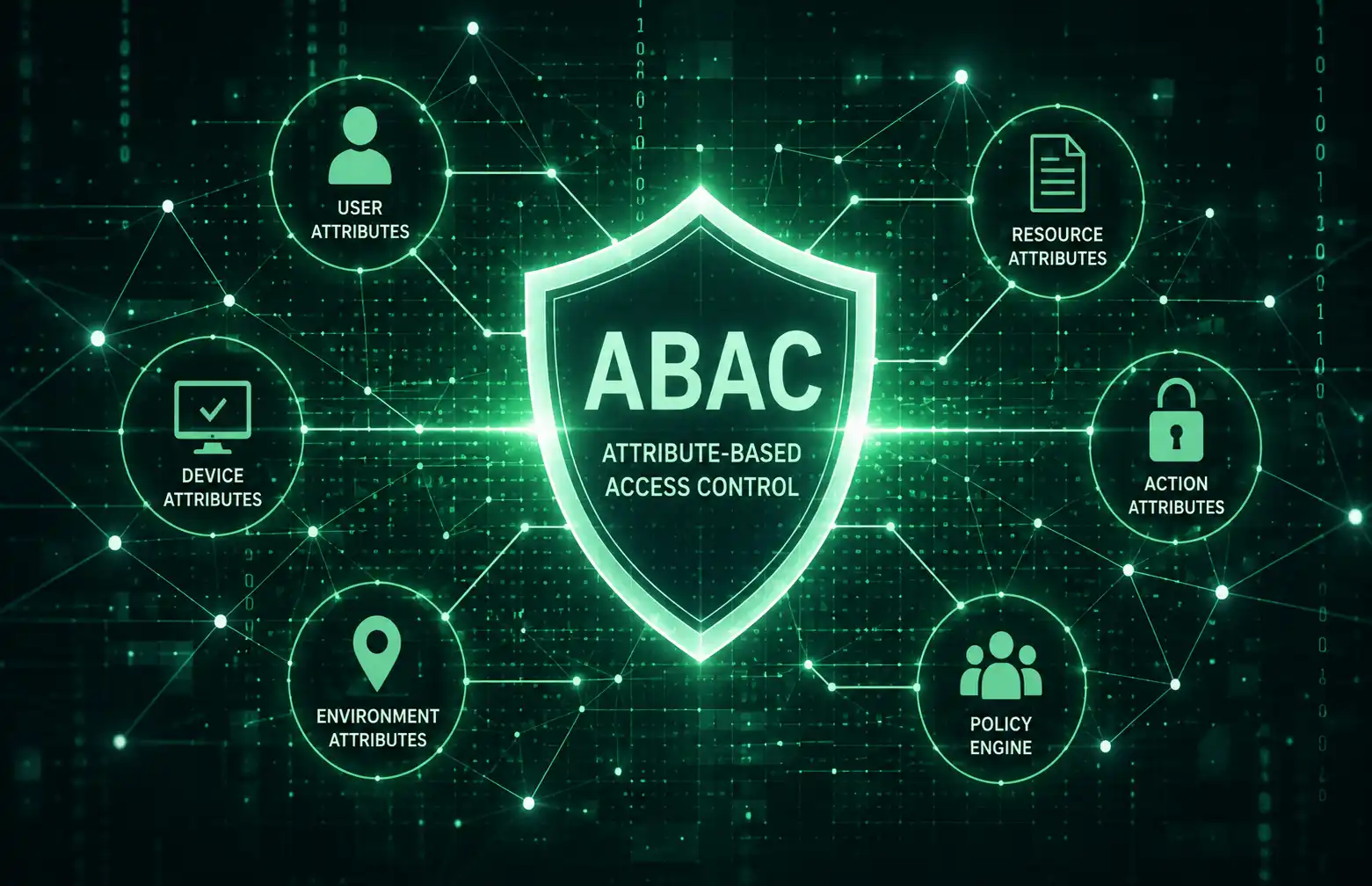
The policy considers attributes from four primary categories:

Subject Attributes

These describe the person or system requesting access.

Examples include:

  • Security clearance
  • Organisation
  • Department
  • Nationality
  • Operational role
  • Mission assignment
  • Need-to-know status
  • Authentication strength

Resource Attributes

These describe the information being protected.

For example:

  • Security classification
  • Data owner
  • Mission relevance
  • Information type
  • Country of origin
  • Data sensitivity
  • Classification caveats
  • Retention policy

Environment Attributes

These describe the context in which access is requested.

Examples include:

  • Time of day
  • Geographic location
  • Device health
  • Network trust level
  • Connected security domain
  • Threat level
  • Current operational status

Action Attributes

These describe what the user wants to do.

Examples include:

  • Read
  • Edit
  • Delete
  • Download
  • Forward
  • Print
  • Export
  • Share with coalition partners

Different actions can require different levels of authorisation.


ABAC versus Role-Based Access Control (RBAC)

Traditional Role-Based Access Control grants permissions based on predefined roles.

For example:

  • Administrator
  • Manager
  • Engineer
  • Finance
  • HR

If a user belongs to that role, they inherit all associated permissions.

This works well in relatively static environments but becomes increasingly difficult when users work across multiple organisations or require temporary access to sensitive information.

ABAC adds another layer of intelligence by evaluating the context of every access request.


Role-Based Access Control (RBAC)

Attribute-Based Access Control (ABAC)

Based on user role

Based on multiple attributes

Static permissions

Dynamic policy decisions

Simple administration

Highly flexible

Limited context awareness

Fully context aware

Difficult for coalition environments

Ideal for multi-organisation collaboration

Coarse-grained permissions

Fine-grained access control


Why ABAC is becoming essential

Modern organisations rarely operate within a single trusted network.

Government departments, defence organisations, critical national infrastructure providers and multinational businesses routinely collaborate across multiple security domains.

Access decisions now depend on far more than simply logging into a corporate network.

For example:

A defence contractor may be cleared to work on one programme but not another.

A coalition partner may be authorised to view operational intelligence but only information originating from specific nations.

A contractor may be permitted to view data while connected through a managed device but prevented from downloading it to a personal laptop.

These complex decisions are exactly what ABAC was designed to support.


ABAC and Zero Trust

ABAC is one of the core technologies underpinning Zero Trust Architecture.

Zero Trust assumes that no user, device or network should be trusted automatically—even if they are already inside the organisation’s network.

Every request must be continuously verified.

ABAC provides the decision-making engine that enables this.

Instead of assuming someone should have access because they successfully logged in earlier, ABAC evaluates every request against current policies and current context.

If circumstances change—for example:

  • the user’s clearance changes,
  • the device becomes non-compliant,
  • the threat level increases,
  • or the requested data carries additional restrictions,

access can immediately be denied.


Protecting data inside trusted networks

Many organisations focus on defending against external cyber threats.

However, some of the greatest security risks originate from legitimate users already inside the network.

An organisation may operate an air-gapped or highly secure network where every user has been authenticated. That does not mean every user should be able to access every piece of information.

Different personnel often hold different security clearances, operational responsibilities and mission assignments.

ABAC allows organisations to enforce strict need-to-know principles by ensuring that access decisions are based on individual attributes rather than simply assuming everyone on the network has identical permissions.

This reduces the risk of accidental disclosure, insider threats and unauthorised access to sensitive or classified information.


ABAC in defence and government

ABAC has become particularly valuable within defence and national security environments.

Military operations increasingly involve:

  • coalition partners
  • government agencies
  • intelligence organisations
  • defence contractors
  • law enforcement
  • emergency responders

Each participant may operate within different security domains while requiring access to shared operational information.

ABAC allows security policies to evaluate factors such as:

  • nationality
  • coalition membership
  • security clearance
  • mission assignment
  • information ownership
  • security labels
  • handling caveats

This enables information sharing while maintaining strict security controls.


ABAC and data-centric security

Traditional security models focused on protecting the network perimeter.

Modern cybersecurity increasingly focuses on protecting the data itself.

Data-centric security ensures that security policies remain attached to information wherever it travels.

ABAC complements this approach by making access decisions based on the security attributes attached to the data rather than relying solely on network boundaries.

Even if information moves between secure environments, its associated security policies remain enforceable.

This makes ABAC an important component of modern information-sharing architectures.


Benefits of Attribute-Based Access Control

Organisations adopting ABAC typically benefit from:

  • Fine-grained access control
  • Stronger protection of sensitive information
  • Dynamic policy enforcement
  • Reduced insider risk
  • Better support for Zero Trust strategies
  • Improved regulatory compliance
  • Easier collaboration across organisations
  • More secure information sharing between security domains
  • Scalable policy management
  • Better support for hybrid and cloud environments

Common use cases

ABAC is increasingly used across sectors where sensitive information must be shared securely.

Typical applications include:

Defence

Managing classified operational information shared between coalition partners.

Government

Controlling access to sensitive citizen data across departments.

Critical National Infrastructure

Protecting operational technology and industrial control systems.

Healthcare

Restricting access to patient records according to clinical responsibilities.

Financial Services

Applying dynamic access policies to sensitive financial information.

Enterprise Collaboration

Ensuring employees only access information relevant to their projects and responsibilities.


How ABAC supports secure collaboration

Modern collaboration platforms must balance usability with strong security.

Users need to exchange information quickly without compromising sensitive data.

ABAC enables collaboration platforms to make intelligent access decisions automatically, ensuring that information is shared only with authorised users under approved conditions.

Rather than creating multiple copies of information for different groups, organisations can maintain a single source of truth while dynamically controlling who can view, edit or share each piece of information.

This improves operational efficiency while reducing security risk.


ABAC and MindLink

Secure collaboration environments increasingly require access decisions that extend beyond simple usernames and passwords.

MindLink supports organisations operating in highly regulated and mission-critical environments where information must be shared securely across users, organisations and security domains.

By integrating with modern security architectures—including Zero Trust approaches, data-centric security models and attribute-driven policy engines—MindLink helps organisations maintain secure, real-time collaboration while ensuring access decisions remain aligned with organisational security policies.

Whether operating within defence, government or critical infrastructure, this approach enables trusted information sharing without sacrificing operational effectiveness.


Frequently Asked Questions

What is Attribute-Based Access Control (ABAC)?

ABAC is an access control model that grants or denies access by evaluating attributes relating to the user, the data, the requested action and the operating environment.


What is the difference between ABAC and RBAC?

RBAC grants permissions based on predefined user roles, while ABAC evaluates multiple attributes in real time, providing much more flexible and context-aware access control.


Is ABAC part of Zero Trust?

Yes. ABAC is widely used within Zero Trust architectures because it enables every access request to be evaluated dynamically rather than relying on implicit trust.


What are examples of attributes?

Typical attributes include security clearance, organisation, nationality, mission assignment, data classification, device compliance, geographic location, time of day and requested action.


Can ABAC protect data inside an air-gapped network?

Yes. Even within isolated or highly secure networks, ABAC helps enforce need-to-know principles by ensuring users only access information appropriate to their role, clearance and operational responsibilities.


Why is ABAC important for defence organisations?

Defence organisations often collaborate with multiple agencies and coalition partners across different security domains. ABAC enables secure information sharing while enforcing security policies based on attributes such as clearance, nationality, mission assignment and data classification.


Related Articles