
8 min read
What Are DDIL Communications? Secure Defence Collaboration
Admin : Nov 4, 2026, 4:51:53 PM
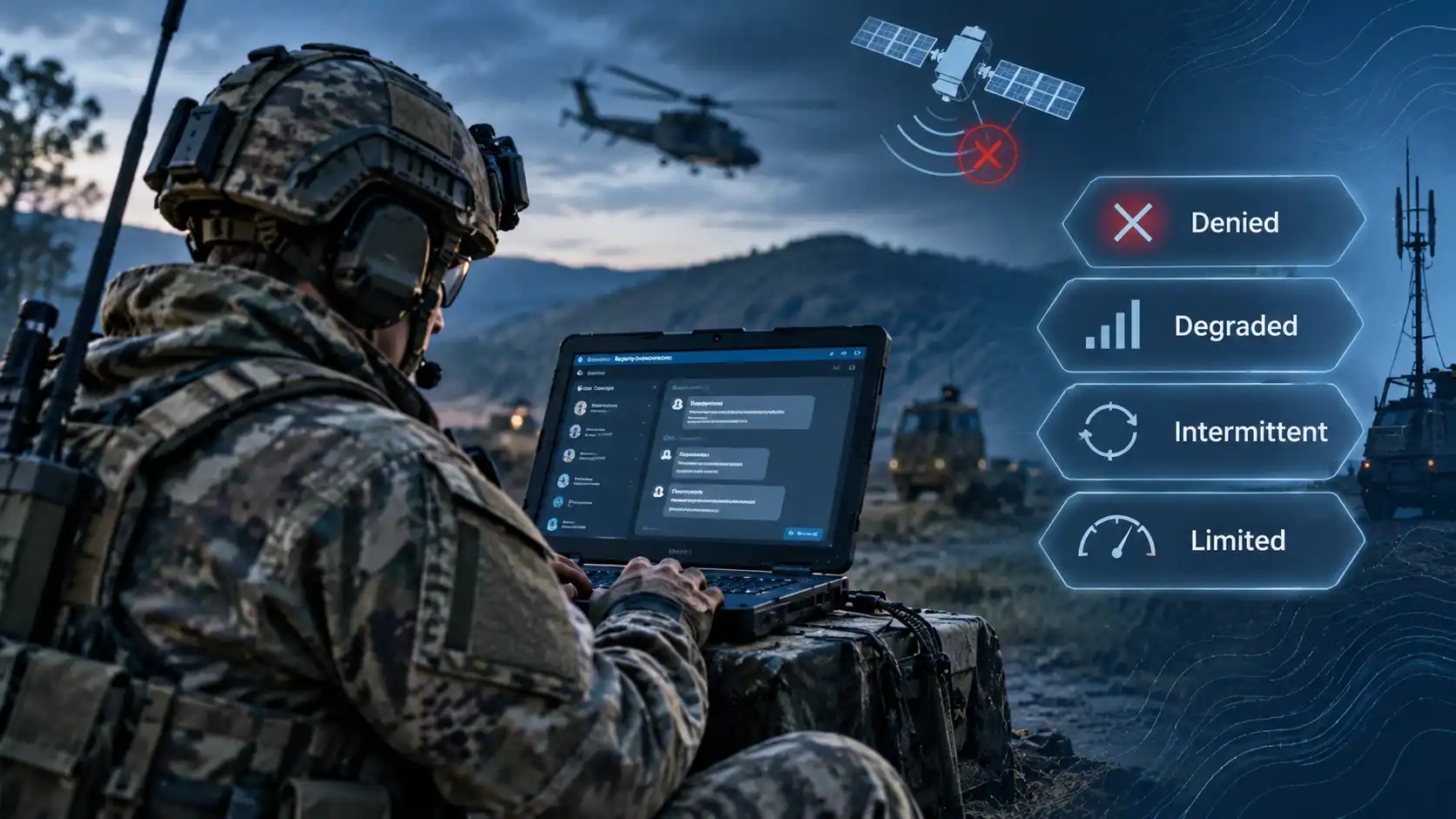
Modern military operations depend on the ability to exchange information quickly, securely and reliably. Yet the environments in which defence organisations operate are rarely guaranteed to provide continuous network connectivity.
Communications may be disrupted by electronic warfare, damaged infrastructure, limited bandwidth, geographic isolation or deliberate attempts to deny access to networks.
These conditions are commonly described as DDIL: Denied, Degraded, Intermittent and Limited communications.
For defence organisations and coalition partners, operating under DDIL conditions presents a challenge that extends beyond maintaining a network connection. Personnel must also be able to collaborate securely, protect sensitive information and make informed decisions when access to centralised systems becomes unreliable.
Understanding how to support secure collaboration in DDIL environments is therefore an important consideration in modern mission-critical communications.
What Are DDIL Communications?
DDIL communications refers to the challenges of exchanging information in environments where network connectivity is denied, degraded, intermittent or limited.
The term is widely used in military and tactical communications to describe operational conditions in which conventional assumptions about network availability, bandwidth and reliability no longer apply.
DDIL encompasses four distinct conditions:
- Denied: Communications are unavailable because network access has been blocked, disrupted or physically lost.
- Degraded: Connectivity remains available, but performance is reduced by factors such as interference, latency, packet loss or congestion.
- Intermittent: Network connections are established and lost unpredictably, creating periods when systems cannot communicate.
- Limited: Communications are constrained by restricted bandwidth, available infrastructure, power or other operational resources.
These conditions may occur independently or in combination.
For example, a military unit operating in a contested environment may experience degraded satellite connectivity while simultaneously losing access to a terrestrial communications network. Another unit may have only intermittent access to a low-bandwidth radio or satellite connection.
In both cases, maintaining effective information exchange becomes significantly more difficult.
Importantly, DDIL is not a particular communications technology or security standard. It describes the operating conditions that communications systems must be designed to accommodate.
Why Do DDIL Conditions Matter in Modern Military Operations?
Modern defence operations increasingly depend on distributed personnel, interconnected systems and information shared between multiple organisations.
Commanders, operational teams, intelligence specialists and coalition partners may be working across different locations, networks and security domains.
Their ability to coordinate activity depends on access to accurate and timely information.
However, military communications infrastructure can be vulnerable to a range of operational challenges.
Electronic Warfare and Deliberate Interference
Adversaries may attempt to disrupt communications through jamming, interference or attacks against network infrastructure.
These activities can reduce network availability or prevent communications altogether.
Geographic and Infrastructure Constraints
Military operations frequently take place in remote locations where terrestrial communications infrastructure is unavailable or unreliable.
Satellite, radio and other communications systems may provide connectivity, but their performance can be affected by terrain, weather, equipment availability and operational restrictions.
Cybersecurity Threats
Cyberattacks may compromise the availability or integrity of communications services.
Defence organisations must therefore consider both the resilience of their networks and the security of the information exchanged across them.
Coalition and Multi-Domain Operations
Joint operations can involve different national networks, security policies, communications technologies and operational procedures.
Even when connectivity is available, interoperability and information-sharing restrictions may complicate collaboration.
DDIL conditions can intensify these challenges by reducing the opportunities for systems and personnel to exchange information.
How Do DDIL Conditions Affect Secure Collaboration?
DDIL environments create challenges for collaboration platforms that assume continuous access to centralised infrastructure.
Many conventional enterprise communications applications depend on reliable connectivity to remote servers or cloud services.
When that connectivity is interrupted, users may lose access to messages, shared information, presence indicators or other collaboration functions.
In a defence environment, these interruptions can have operational consequences.
Delayed Information Exchange
Messages, intelligence updates and operational instructions may not reach their intended recipients within the required timeframe.
Systems must distinguish between information that has been created, transmitted, received and acknowledged.
Reduced Situational Awareness
When information cannot be exchanged consistently, different operational teams may develop incomplete or outdated views of the same situation.
This can complicate coordination and decision-making.
Fragmented Collaboration
Personnel may resort to alternative communications channels when their primary collaboration platform becomes unavailable.
Without appropriate controls, these alternatives can introduce security, interoperability and information-management risks.
Challenges Maintaining Security Policies
Intermittent connectivity can make it harder for distributed systems to obtain current identity, authorisation or policy information.
Security architectures must account for how access decisions are enforced when central services cannot be reached.
These challenges demonstrate why secure collaboration in DDIL environments requires consideration of both communications availability and information protection.
What Is the Difference Between Communications Resilience and Information Security?
Communications resilience and information security are closely related, but they address different requirements.
Communications resilience concerns the ability to maintain or recover information exchange despite disruptions. Information security concerns protecting information against unauthorised access, alteration or disclosure.
A resilient network may use multiple communications paths, alternative transmission technologies or mechanisms for recovering from connection failures.
However, these capabilities do not automatically ensure that information is handled securely.
Equally, an encrypted messaging platform may protect information during transmission while remaining dependent on a network connection that is unavailable during a DDIL event.
Defence organisations must therefore consider both requirements together.
A secure communications architecture should address:
- Confidentiality: Ensuring information is accessible only to authorised individuals and systems.
- Integrity: Protecting information against unauthorised modification.
- Availability: Supporting access to information and services when operationally required.
- Authentication: Establishing the identity of users and participating systems.
- Authorisation: Enforcing appropriate restrictions on information access.
- Auditability: Maintaining records of relevant activity where operationally and technically feasible.
In DDIL environments, achieving these objectives may require different technical approaches depending on the available infrastructure, security classification and mission requirements.
Supporting Secure Collaboration at the Tactical Edge
The tactical edge refers to operational environments where personnel and systems operate close to the point of mission execution, often with constrained access to central communications infrastructure.
Examples include deployed military units, forward command posts, mobile operational teams and distributed intelligence assets.
In these environments, secure collaboration may need to operate across local infrastructure rather than depend entirely on centrally hosted services.
Locally Available Collaboration Services
Where operational requirements permit, collaboration services can be deployed within controlled local environments.
This can allow personnel connected to the same local infrastructure to continue collaborating even when external connectivity is unavailable.
However, local deployment does not automatically guarantee DDIL resilience. Continued operation depends on factors including local network availability, service dependencies, power, identity management and the architecture of the application itself.
On-Premise and Private Infrastructure
Defence organisations may require communications systems to operate within infrastructure they own or control.
On-premise deployment can reduce dependence on external cloud connectivity and support organisational requirements concerning information handling and operational sovereignty.
Nevertheless, an on-premise platform remains dependent on the availability of its underlying infrastructure.
Managing Constrained Bandwidth
Where connectivity is limited, communications architectures may need to prioritise essential information.
Depending on the technologies deployed, approaches can include message prioritisation, bandwidth management, reduced data overhead and mechanisms for handling interrupted transmissions.
These capabilities must be evaluated at the application and network levels rather than assumed to be inherent features of secure messaging software.
Maintaining Access Controls
Operational disruption should not automatically result in the removal of security controls.
Local systems may need access to appropriate identity, credential and policy information to make authorisation decisions while disconnected from central services.
The mechanisms used must reflect the organisation's security requirements, including how changes to permissions or revoked credentials are handled during periods of disconnection.
Why Is Federation Important in Disrupted Communications Environments?
Federation enables separate systems or organisations to exchange information while maintaining defined boundaries between their respective environments.
In defence operations, this can be important when different military units, government agencies or coalition partners use independently managed communications infrastructure.
Rather than requiring every participant to operate within one centralised system, a federated architecture can support controlled communication between participating environments.
This approach may offer architectural flexibility where operational teams use separate networks or administrative domains.
However, federation should not be confused with guaranteed connectivity.
Federated systems still require an available communications path to exchange information between environments. Where that path is denied, cross-network information exchange may be interrupted.
The resilience of a federated architecture therefore depends on its specific implementation, the availability of participating systems and the mechanisms provided for handling communications disruptions.
For defence organisations, the objective is to combine interoperability with appropriate information-sharing controls.
Related reading: What Is Secure Federation?
How Does Data-Centric Security Support DDIL Operations?
Traditional security architectures frequently place significant emphasis on protecting networks and their boundaries.
Although network protection remains essential, defence information may need to move between different systems, organisations and operational environments.
Data-centric security addresses this challenge by placing greater emphasis on protecting information itself.
Security labels, metadata, identity attributes and access-control policies can help determine how information should be handled, regardless of the particular network carrying it.
This is relevant in DDIL environments because information may need to be stored locally, exchanged through alternative communications paths or shared between separately managed systems.
However, information protection must remain enforceable when connectivity is disrupted.
For example, a system that depends entirely on contacting a central authorisation service may be unable to make new access decisions while disconnected.
Appropriate local enforcement mechanisms can help address this dependency, subject to the security architecture and operational policies in use.
Standards such as NATO STANAG 4774 and STANAG 4778 provide approaches to security labelling and metadata binding, but they do not themselves provide network resilience or guarantee communications availability.
Their role is to support the protection and handling of information, complementing the communications infrastructure used to exchange it.
Related reading: What Is Data-Centric Security?
What Should Defence Organisations Look for in a DDIL-Aware Collaboration Architecture?
Organisations evaluating secure collaboration for disrupted or contested environments should assess how the complete system behaves under realistic operational conditions.
Important considerations include:
1. Deployment flexibility
Can collaboration services operate within approved on-premise, private or locally controlled infrastructure?
2. Dependence on external services
Which functions require connectivity to central servers, cloud platforms, identity providers or other external dependencies?
3. Local operational continuity
What collaboration functions remain available when external network connections are lost?
4. Security enforcement
How are authentication, authorisation and information-handling policies maintained during disrupted connectivity?
5. Interoperability
Can the platform exchange information with other authorised systems and communications environments?
6. Recovery following disruption
How does the system handle reconnection, message delivery, information consistency and recovery after an outage?
7. Operational assurance
Has the complete solution been tested under representative conditions involving latency, packet loss, restricted bandwidth and network interruption?
These questions help distinguish a secure collaboration product from a communications architecture designed and validated for DDIL operating conditions.
How Does MindLink Support Secure Mission-Critical Collaboration?
MindLink provides secure collaboration capabilities designed for organisations operating in security-sensitive and mission-critical environments.
Its approach to secure communications, deployment flexibility and interoperability is relevant to defence organisations seeking greater control over how information is exchanged.
For environments where public cloud services are unsuitable, controlled deployment options can form an important part of the overall communications architecture.
MindLink's focus on secure collaboration and information-sharing controls also aligns with the requirements of organisations that need to manage sensitive information across different operational communities.
In DDIL environments, these capabilities should be considered as components of a wider architecture that includes resilient network infrastructure, appropriate local services, identity and policy enforcement, and tested operational recovery procedures.
The precise level of functionality available during a communications disruption will depend on the deployed MindLink configuration, its dependencies and the wider system design.
Secure collaboration in contested environments is not simply about keeping a connection available. It is about ensuring that information remains appropriately protected, accessible and usable throughout changing operational conditions.
Frequently Asked Questions About DDIL Communications
What does DDIL stand for in military communications?
DDIL stands for Denied, Degraded, Intermittent and Limited. It describes operating conditions in which communications networks are unavailable, unreliable, periodically disconnected or constrained by resources such as bandwidth.
What is a DDIL environment?
A DDIL environment is an operational setting where communications cannot be assumed to be continuously available or reliable. Examples include contested military environments, remote deployments and operations affected by electronic warfare or infrastructure disruption.
Why are DDIL communications important in defence?
DDIL communications are important because military personnel and coalition partners may need to coordinate activity and exchange sensitive information despite network disruption. Communications architectures must account for these conditions while maintaining appropriate security controls.
Can secure messaging work without an internet connection?
Some secure messaging systems can operate over local or privately managed networks without a public internet connection. However, this depends on their deployment architecture and service dependencies. Offline message creation, delivery and synchronisation are separate capabilities that must be specifically supported.
Is DDIL the same as an air-gapped network?
No. DDIL describes communications conditions, whereas an air-gapped network is deliberately isolated from other networks. An air-gapped system may have reliable internal connectivity, while a DDIL environment may experience unreliable or unavailable connections. The two can overlap but are not equivalent.
How does federation help with DDIL communications?
Federation can enable controlled information exchange between separately managed systems and networks. It may provide architectural flexibility for distributed operations, but it does not eliminate the need for available communications paths or appropriate recovery mechanisms.
What is the relationship between DDIL and Zero Trust?
Zero Trust is a security approach that avoids granting implicit trust based solely on network location. DDIL describes communications constraints. Zero Trust principles can inform how access is controlled in disrupted environments, but the architecture must account for the availability of identity and policy services.
How can organisations improve collaboration in DDIL environments?
Organisations can improve their readiness by reducing unnecessary dependencies on external services, assessing locally deployable collaboration capabilities, implementing appropriate information-security controls, designing for connectivity disruption and testing the complete solution under realistic operational conditions.
Building Secure Collaboration for Contested Environments
Denied, degraded, intermittent and limited communications are a practical reality of modern defence operations.
As military organisations become increasingly dependent on distributed information systems, the ability to collaborate securely under disrupted network conditions becomes an important operational requirement.
Achieving this requires more than resilient connectivity alone.
Defence organisations must consider how collaboration services are deployed, how information is protected, how different systems interoperate and what happens when communications infrastructure becomes unavailable.
By combining appropriate network resilience with secure collaboration, controlled information sharing and effective security enforcement, organisations can build architectures better suited to the demands of contested operational environments.
To discuss secure collaboration requirements for defence and mission-critical environments, contact MindLink.