3 min read

On-Premise Microsoft Teams Alternative | MindLink

On-Premise Microsoft Teams Alternative | MindLink

Selecting a collaboration platform for a classified environment starts with the conditions under which people must work. Where can information be processed? Which external services can the network reach? Who can participate in a conversation, and what happens when their permissions change?

For organisations evaluating an on-premise Microsoft Teams alternative, these questions should shape the shortlist before individual features are compared.

The aim is to identify a platform that supports the required mission workflows within an approved operating environment. That requires a clear specification and evidence that the proposed deployment can meet it.

Start with the workflows you need to support

“Replace Teams” can mean different things to different stakeholders.

One team may need persistent group conversations and searchable history. Another may depend on meetings, screen sharing, document collaboration or application integrations. Operational users may prioritise monitoring several conversations and maintaining continuity between watches.

Document these requirements separately. Identify which capabilities are essential, which are desirable and which can be provided through another approved system.

This helps establish whether the requirement is for a complete collaboration suite, a specialist mission messaging platform or a combination of services.

1. Establish the complete deployment boundary

An on-premise server does not, by itself, demonstrate that the entire service can operate within an isolated network.

Ask suppliers to identify every component required for installation, authentication, normal operation, administration and recovery. Include supporting services such as licensing, certificates, notifications, updates and technical support.

Microsoft documents that Teams uses multiple Microsoft 365 and Office 365 services, with dependencies affecting the functionality available to users. Buyers should apply the same scrutiny to any proposed alternative and understand its complete dependency chain. Microsoft’s documentation on Teams dependencies.

Request this evidence: a deployment diagram showing required connections, the information exchanged and the effect of losing each dependency.

2. Test access using realistic information boundaries

A convincing demonstration should reflect the people and information involved in your operation.

Create test users with different organisations, roles, clearances and mission assignments. Define which conversations and information each user should be able to access.

Then test changes. What happens when someone leaves a mission, changes role or loses an entitlement? How are historical messages, attachments and search results handled?

For background on the access model, see our explanation of attribute-based access control.

Request this evidence: a demonstration of permitted and denied access, including the behaviour after an entitlement changes.

3. Evaluate collaboration with mission partners

External participation introduces decisions about identity, administration and information ownership.

Determine who approves a partner’s access, which organisation manages their identity and how access is withdrawn. Establish whether partner users join a shared environment or communicate between independently managed deployments.

Where federation is required, test the specific information exchange and failure scenarios your organisation expects to encounter. Our introduction to secure federation explains the underlying approach.

Request this evidence: a representative partner collaboration scenario with explicit ownership, access and offboarding responsibilities.

4. Prove that operational conversations remain usable

Security controls must work alongside the way personnel communicate.

Use a realistic exercise to assess how users find relevant conversations, distinguish participants, review earlier decisions and resume work after an absence. Include the volume of activity and number of concurrent conversations expected in service.

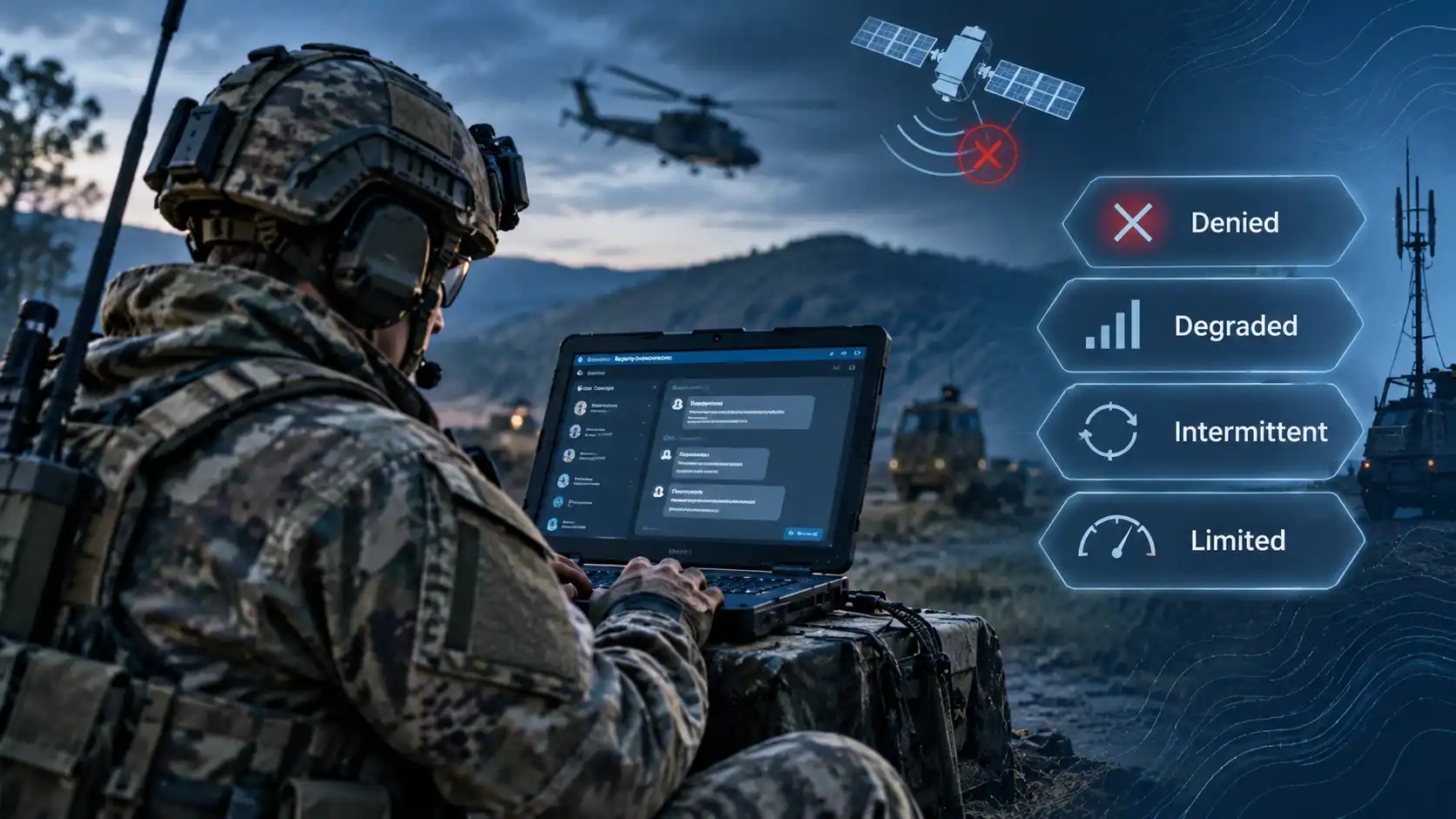
If the deployment includes constrained connectivity, agree measurable test conditions. Record what users experience during interruption and recovery, including how the system indicates delivery status.

Request this evidence: results against agreed operational tasks and network conditions.

5. Examine administration and recovery

The people maintaining the service need a workable operating model.

Establish responsibilities for provisioning, policy changes, patching, backup, recovery and incident investigation. Determine which activities require supplier involvement and how that support can be delivered within the environment’s access restrictions.

Include administrators in the evaluation. Their ability to maintain the deployment is part of its operational suitability.

Request this evidence: documented maintenance and recovery procedures, supported by a witnessed recovery exercise.

Turn the shortlist into an acceptance plan

Before running a proof of concept, agree what constitutes a pass.

A useful acceptance plan should cover:

  • Operation within the permitted network boundary.
  • Correct access decisions for representative users.
  • Controlled participation by mission partners.
  • Completion of essential user workflows.
  • Behaviour during service or connectivity disruption.
  • Administration, backup and recovery.

Record results for the exact configuration being proposed. Any security approval should address that deployment, its integrations and its operating procedures.

Where MindLink fits

MindLink provides secure mission collaboration with persistent group chat, attribute-based access controls and federation capabilities. Its platform is designed for national security and defence information-sharing requirements. Explore the MindLink platform.

For organisations evaluating an on-premise Microsoft Teams alternative, the next step is to map those capabilities against the workflows, information boundaries and deployment conditions that matter to their mission.

Speak to MindLink about your collaboration requirements.

What Are DDIL Communications? Secure Defence Collaboration

What Are DDIL Communications? Secure Defence Collaboration

Modern military operations depend on the ability to exchange information quickly, securely and reliably. Yet the environments in which defence...
Read More
What Is NATO STANAG 4774? Security Labels Explained | MindLink

What Is NATO STANAG 4774? Security Labels Explained | MindLink

Modern defence operations depend on information moving quickly between people, systems, organisations and coalition partners. But sharing information...
Read More
What Is Need-to-Know Access? | Classified Information | MindLink

What Is Need-to-Know Access? | Classified Information | MindLink

Protecting classified information is not simply a question of deciding who is trusted.

Read More